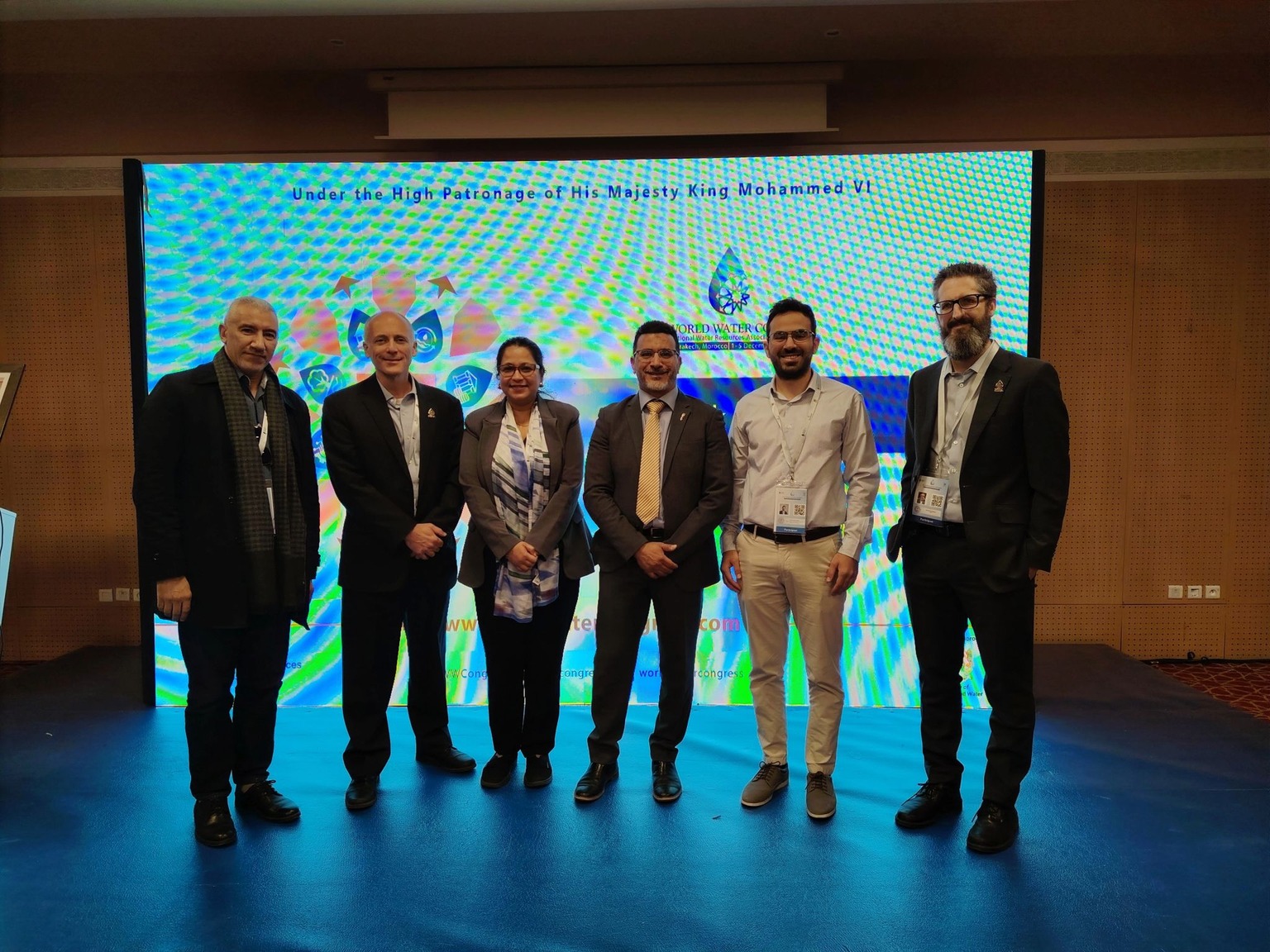
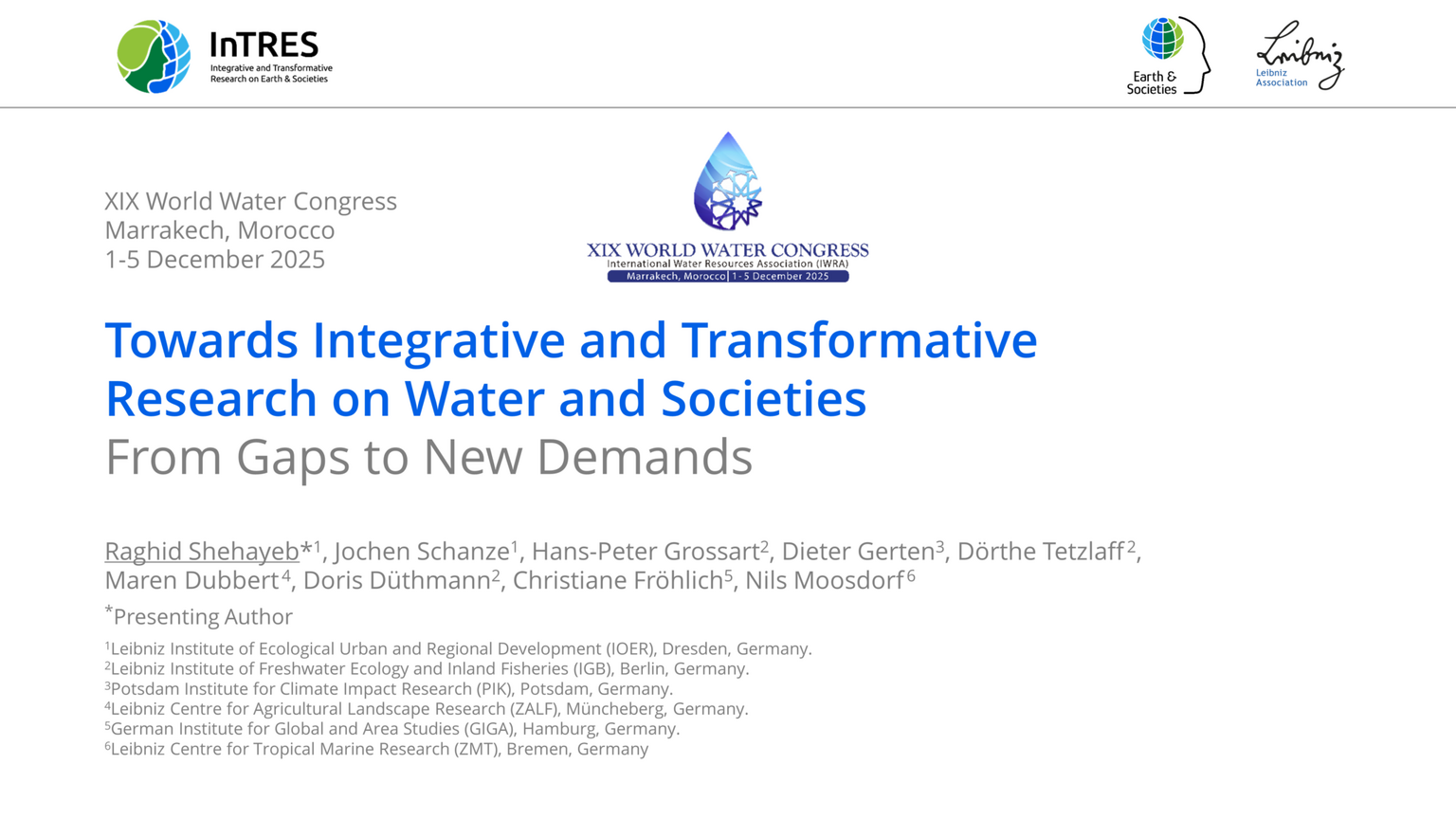
The Leibniz Research Network ‘Earth & Societies’ successfully contributed to the XIX World Water Congress in Marrakech organised by the International Water Resources Association through the working group ‘Freshwater & Societies’. The scientific coordinator and working group co-chair, Raghid Shehayeb, presented on the Integrative and Transformative Research on Water and Societies, exploring the research gaps and identifying the demands.
The global water cycle and inland water balances are undergoing critical changes in the Anthropocene. Significant disruptions to the interlinkages between water, other components of the Earth system, and societies have increased the risks for ecosystems and people. Many aspects of these challenges are subject of ongoing research. Yet, the extent to which the current research is able to meet the challenges of the highly complex and dynamic interlinkages between water and societies, and what additional research demands exist remain unclear. Accordingly, this presentation (i) outlines current key research trends and limitations and (ii) derives the emerging research demands.
Current research on water can be categorised into natural sciences, social sciences, and integrated approaches. The natural sciences in the Anthropocene context are particularly concerned with analyzing the impacts of climate change on the hydrosphere (e.g., IPCC) and the non-linear feedbacks between changes in hydrological processes and the biosphere (e.g., IPBES). The main topics of water-related research in the social sciences range from spatial water accessibility and economics of water use to people’s vulnerability to exacerbating water extremes, cross-border water-conflicts and water governance (e.g., UN Agenda 2030; Global Commission on the Economics of Water). Integrated approaches have gained importance in last two decades, such as global water quality and health assessments (e.g., WHO), global water-related disaster risk management (e.g., UNDRR), Integrated Water Resources Management, and the water security concept (World Water Council). Despite their contributions to the water challenges of the Anthropocene, these approaches had so far, some limitations. In particular, there is a lack of: cross-scale analyses that capture the bidirectional feedbacks between water and societies; critical regional and global water thresholds in the context of societal well-being and justice; and understanding and developing societal capacities for governing water as a component of the Earth system and a fundamental resource for sustainable development.
Against this background, three major areas of future water research have been identified as urgent demands considering system, target, and transformation knowledge: (i) Coupled systems approaches for water and societies to deal with the comprehensiveness and dynamics of the interlinkages; (ii) System-based scientific references for societal agreement on water-related boundaries and global goals according to the demand for global to local evaluation references (e.g., water-related SDGs within planetary boundaries); and (iii) Systemic innovations promoting societal transformations.
The talk was presented under the session “Water for Sustainable Development” on 03 December, 2025.
More information on the XIX World Water Congress: https://worldwatercongress.com/